Artist Statement
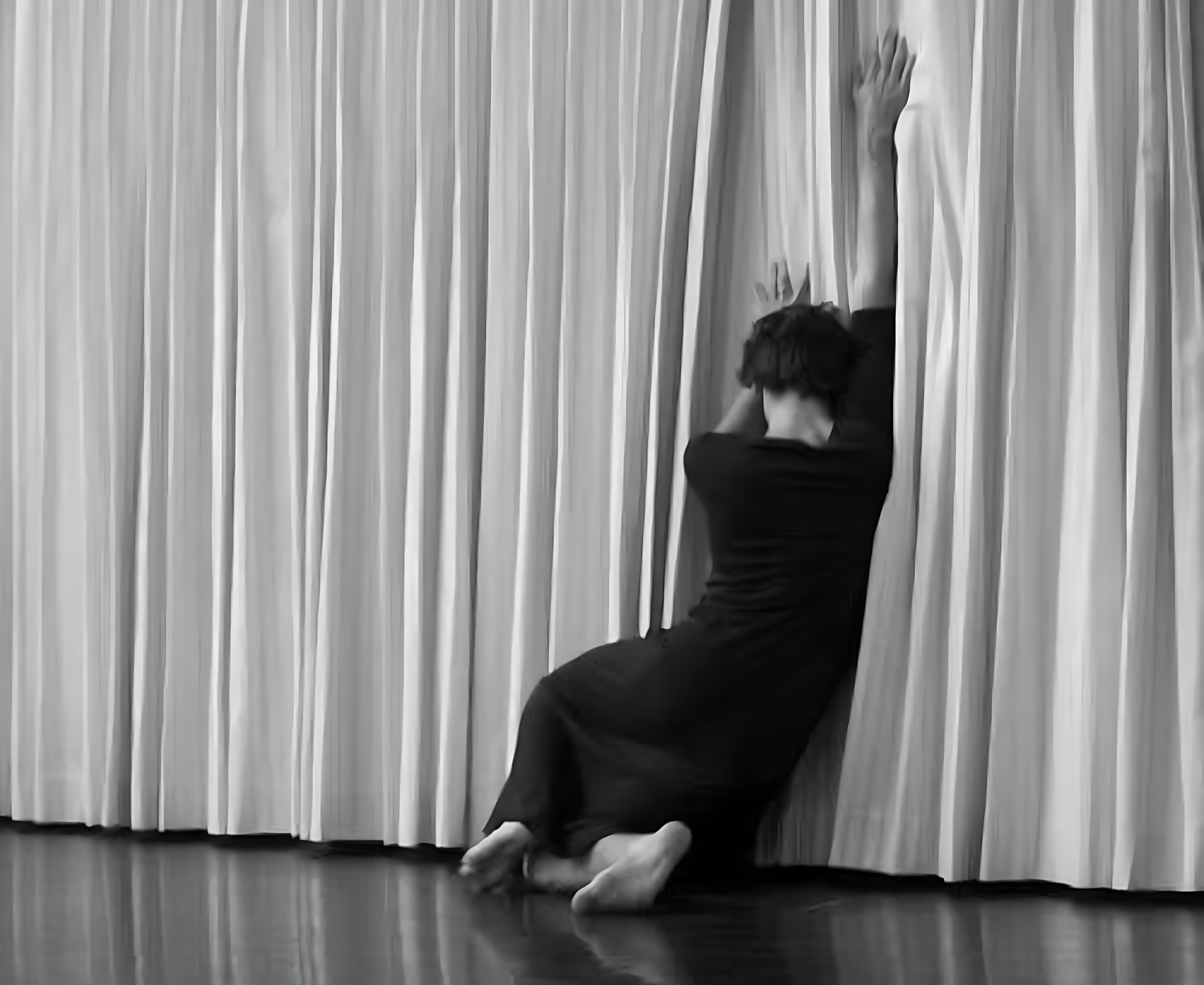
I write and make dances from the same place—an urgent need to metabolize loss, pain, joy, madness, attunement to nature, and the tension between separateness and belonging. I document time as it folds in on itself—how memory behaves nonlinearly, collapsing past, present, and future into a single, lived moment.
I center myself as the speaker, while the subject continually shifts. My work is often driven by experiences I could not face when they occurred—moments I could not name or share until now. Through the body, words become images, and movement speaks where language cannot.
My works arrive like visitors. I receive them as they come, translating images, sensations, and memories into words or movement before they disappear. I do not approach making with preciousness; it emerges from a deeply felt place.
I want the work to be understood not only intellectually, but physically—felt in the body of the reader or audience member.
DURAN DANCE
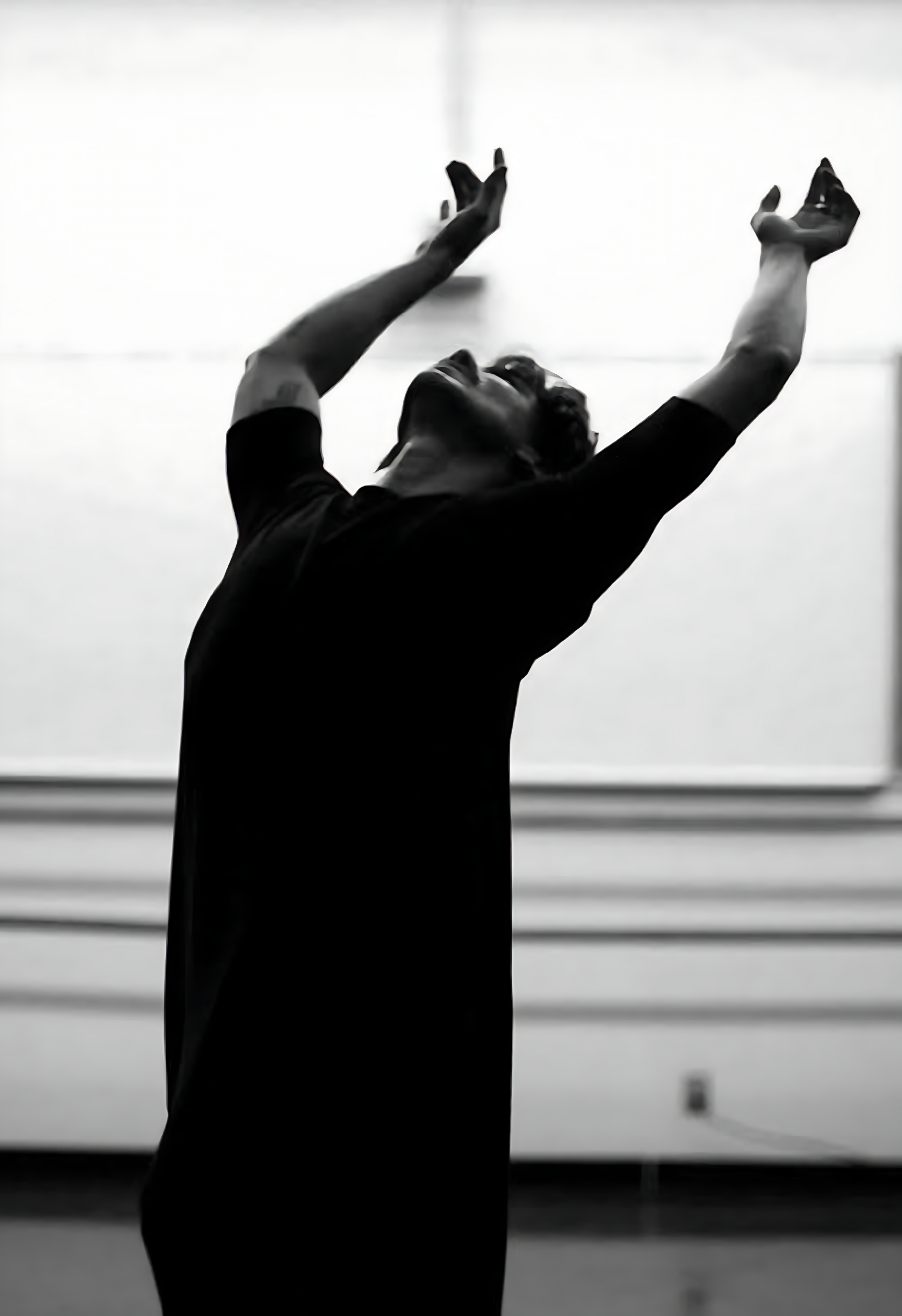
Duran Dance creates contemporary performance works from the understanding that the body encounters experience differently than words do. Founded in Mexico City by choreographer Nick Duran, the company explores grief, longing, memory, belonging, and the ways the past continues to emerge within the present.
Drawing from somatic practice, improvisation, and contemporary dance, the work emerges from images, sensations, dreams, and lived experience. Choreography is developed through close attention to what surfaces in the body before it can be fully understood—a gesture, a memory, a feeling, an encounter with the natural world.
Rather than telling stories, Duran Dance creates spaces where memory folds, time collapses, and movement becomes a way of witnessing what remains. The work invites audiences into an experience that is visceral rather than explanatory, asking not only to be watched, but felt.
Duran Dance crea obras de danza contemporánea a partir de la comprensión de que el cuerpo se relaciona con la experiencia de una manera distinta a las palabras. Fundada en la Ciudad de México por el coreógrafo Nick Duran, la compañía explora el duelo, el anhelo, la memoria, la pertenencia y las formas en que el pasado continúa emergiendo en el presente.
Nutrido por la práctica somática, la improvisación y la danza contemporánea, el trabajo surge de imágenes, sensaciones, sueños y experiencias vividas. La coreografía se desarrolla a través de una escucha atenta de aquello que aparece en el cuerpo antes de poder comprenderse por completo: un gesto, un recuerdo, una emoción o un encuentro con el mundo natural.
Más que contar historias, Duran Dance crea espacios donde la memoria se pliega sobre sí misma, el tiempo se colapsa y el movimiento se convierte en una forma de atestiguar lo que permanece. La obra invita al público a vivir una experiencia visceral más que explicativa, una experiencia que no sólo busca ser observada, sino también sentida.
Teaching Dance and Somatics
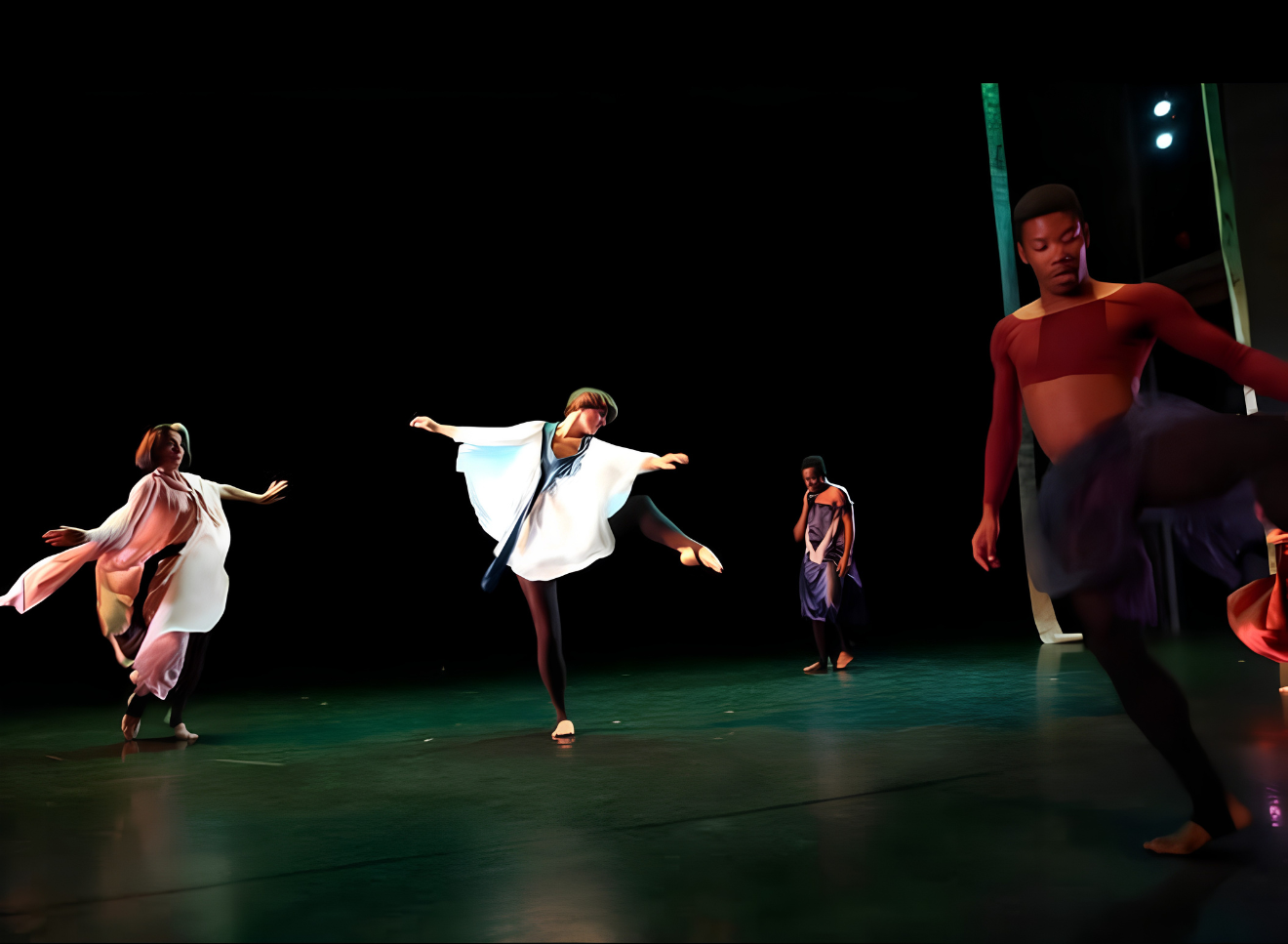
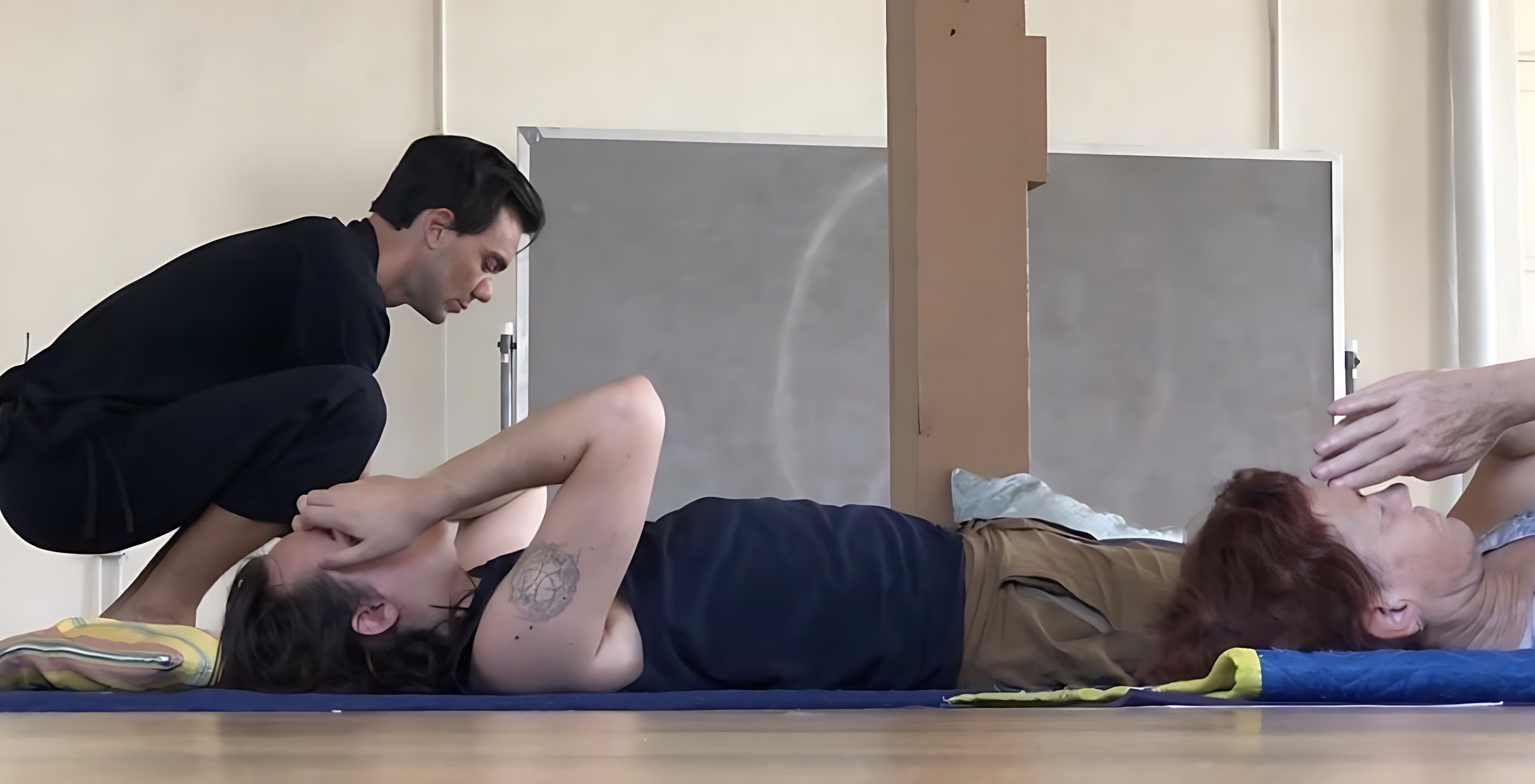
Since 2008, Nick has developed an integrative approach to teaching dance and somatics grounded in his training as a Master of Fine Arts candidate in Dance at the University of Illinois. His work synthesizes modalities including Body-Mind Centering, Authentic Movement, the Feldenkrais Method, the Alexander Technique, Ideokinesis, and Skinner Releasing, bridging creative practice, pedagogy, and embodied inquiry.
Duran has taught somatics and dance across higher education institutions including the University of California, Los Angeles; California State University, Long Beach; Loyola Marymount University; the University of North Carolina Asheville; and Whitman College. As a counselor, he has facilitated therapy groups integrating somatic and expressive arts approaches, including I Am Not My Thoughts: Somatic Practices for Anxiety and Depression, In-Between and Beyond: Mind-Body Practices for the Non-Binary Experience, Safer Than Words, and You Are Welcome Here.
His work with professional artists includes long-running classes such as SEAT (Somatic and Expressive Arts Techniques) (2020–2025), Self Healing: We Are All Connected (2019–2020), and Physical Practice (2011–2015), as well as teaching Kundalini Yoga and Reiki. Across contexts, his teaching centers the body as a site of attention, creativity, and transformation.
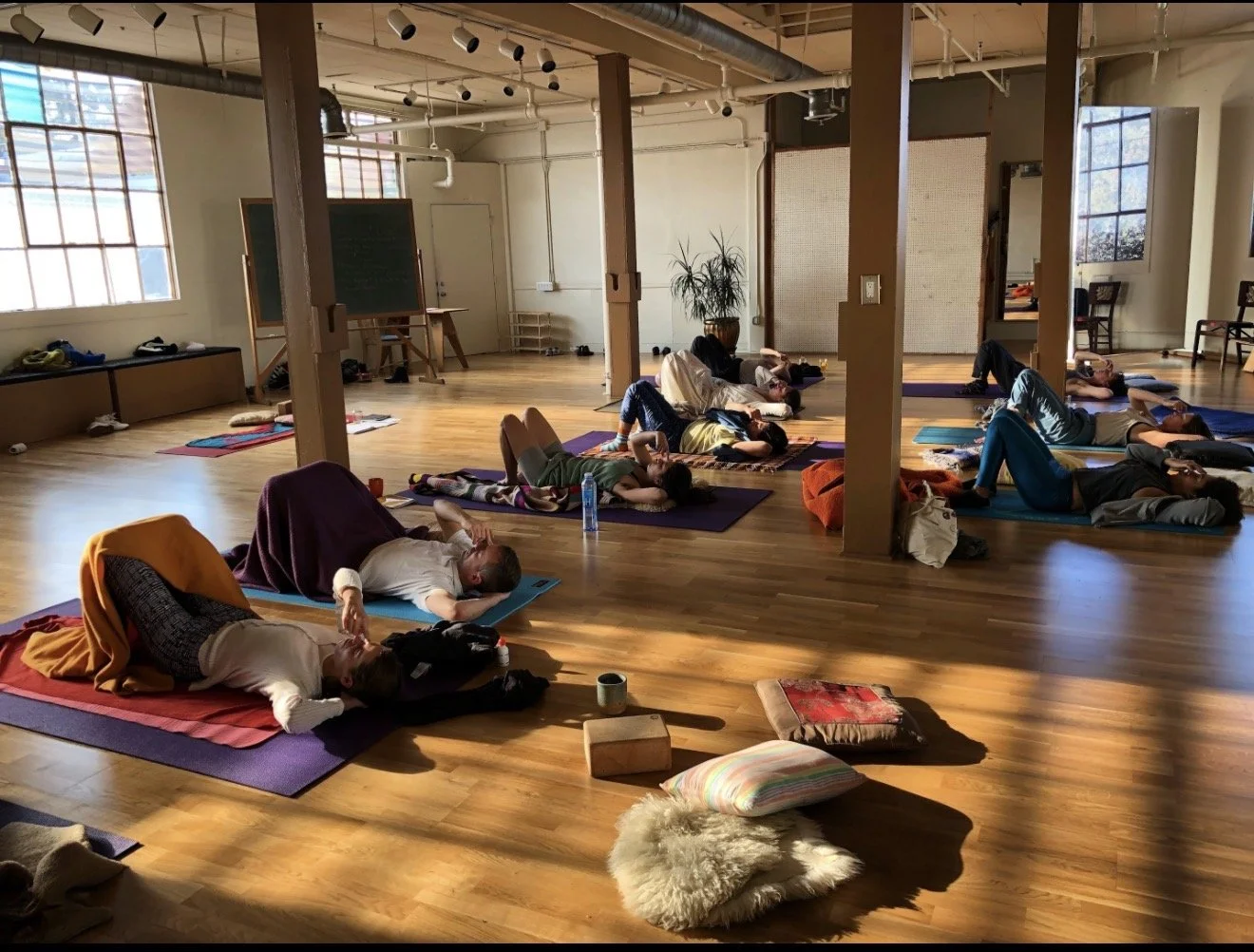
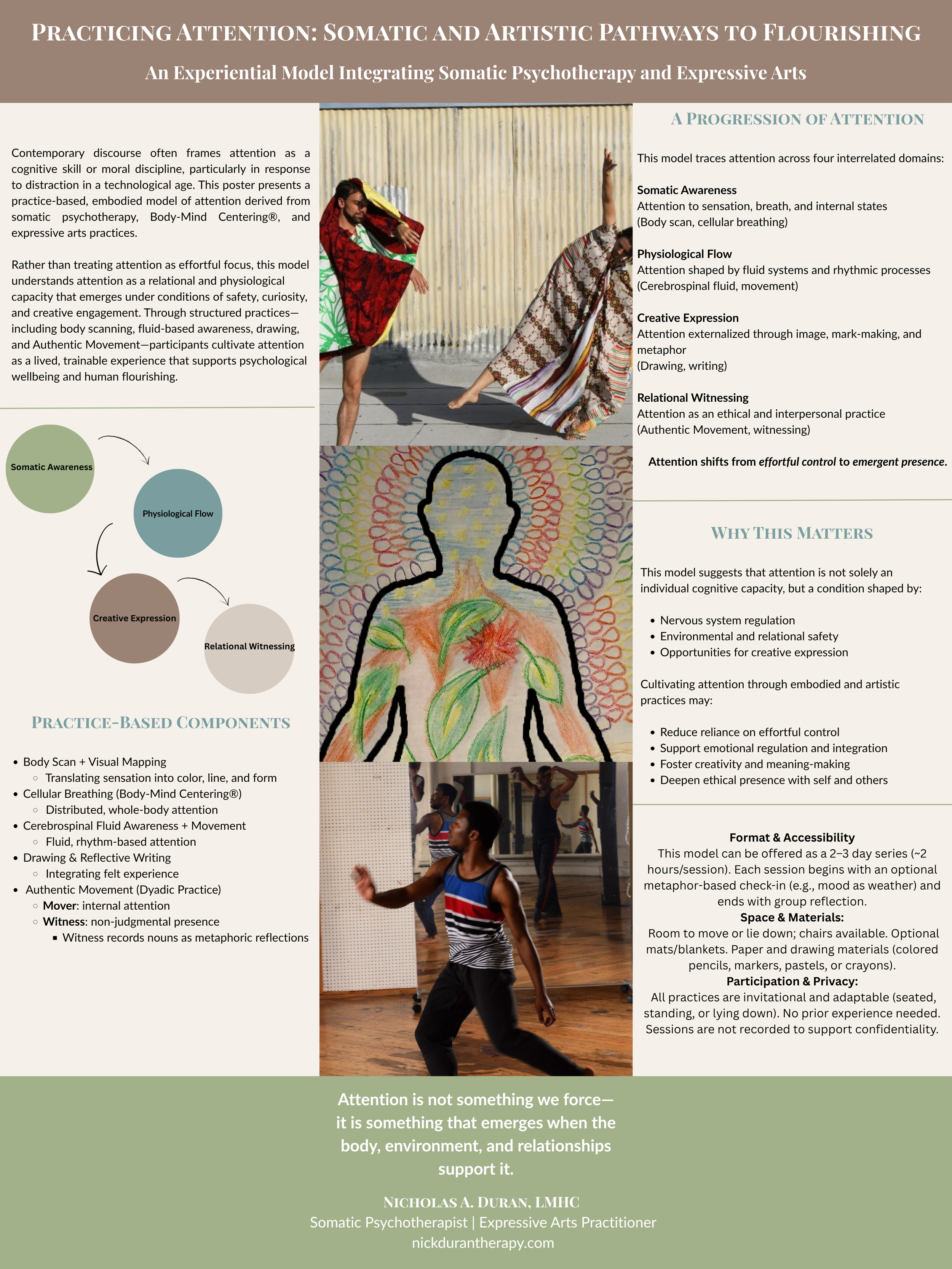
This poster presents a practice-based, embodied model of attention integrating somatic psychotherapy, Body-Mind Centering®, and expressive arts practices. It responds to ongoing interdisciplinary conversations about attention, mental health, and flourishing by reframing attention not as a purely cognitive skill or moral discipline, but as a relational and physiological capacity shaped by bodily states, environmental context, and interpersonal conditions.
Contemporary discourse often positions attention in terms of effort, control, or resistance to distraction. While valuable, such approaches risk overlooking the ways attention is supported—or constrained—by the nervous system and by lived, embodied experience. This model proposes that attention is less something to be sustained through effort and more something that emerges under conditions of safety, curiosity, and creative engagement.
Drawing from clinical and artistic practice, the model traces attention across four interrelated domains: (1) somatic awareness, including sensation and breath; (2) physiological flow, with particular attention to fluid systems and rhythmic processes; (3) creative expression, in which attention is externalized through image, mark-making, and metaphor; and (4) relational witnessing, where attention becomes an ethical and interpersonal act. These domains are illustrated through practices such as body scanning and visual mapping, fluid-based imagery and movement, reflective drawing or writing, and dyadic witnessing adapted from Authentic Movement.
By mapping these domains, the poster highlights how attention shifts from effortful control toward emergent presence as conditions become more supportive and integrated. This shift has implications for both mental health and artistic practice, suggesting that attention may be cultivated indirectly through somatic regulation, environmental design, and relational attunement.
This practice-based framework contributes to a broader understanding of attention as dynamic, trainable, and context-dependent. It invites reconsideration of how attention is fostered within therapeutic, artistic, and everyday settings, and how such approaches may support more expansive and humane notions of flourishing.
Practicing Attention:
Somatic and Artistic
Pathways to Flourishing