Practicing Attention:
Somatic and Artistic
Pathways to Flourishing
This poster presents a practice-based, embodied model of attention integrating somatic psychotherapy, Body-Mind Centering®, and expressive arts practices. It responds to ongoing interdisciplinary conversations about attention, mental health, and flourishing by reframing attention not as a purely cognitive skill or moral discipline, but as a relational and physiological capacity shaped by bodily states, environmental context, and interpersonal conditions.
Contemporary discourse often positions attention in terms of effort, control, or resistance to distraction. While valuable, such approaches risk overlooking the ways attention is supported—or constrained—by the nervous system and by lived, embodied experience. This model proposes that attention is less something to be sustained through effort and more something that emerges under conditions of safety, curiosity, and creative engagement.
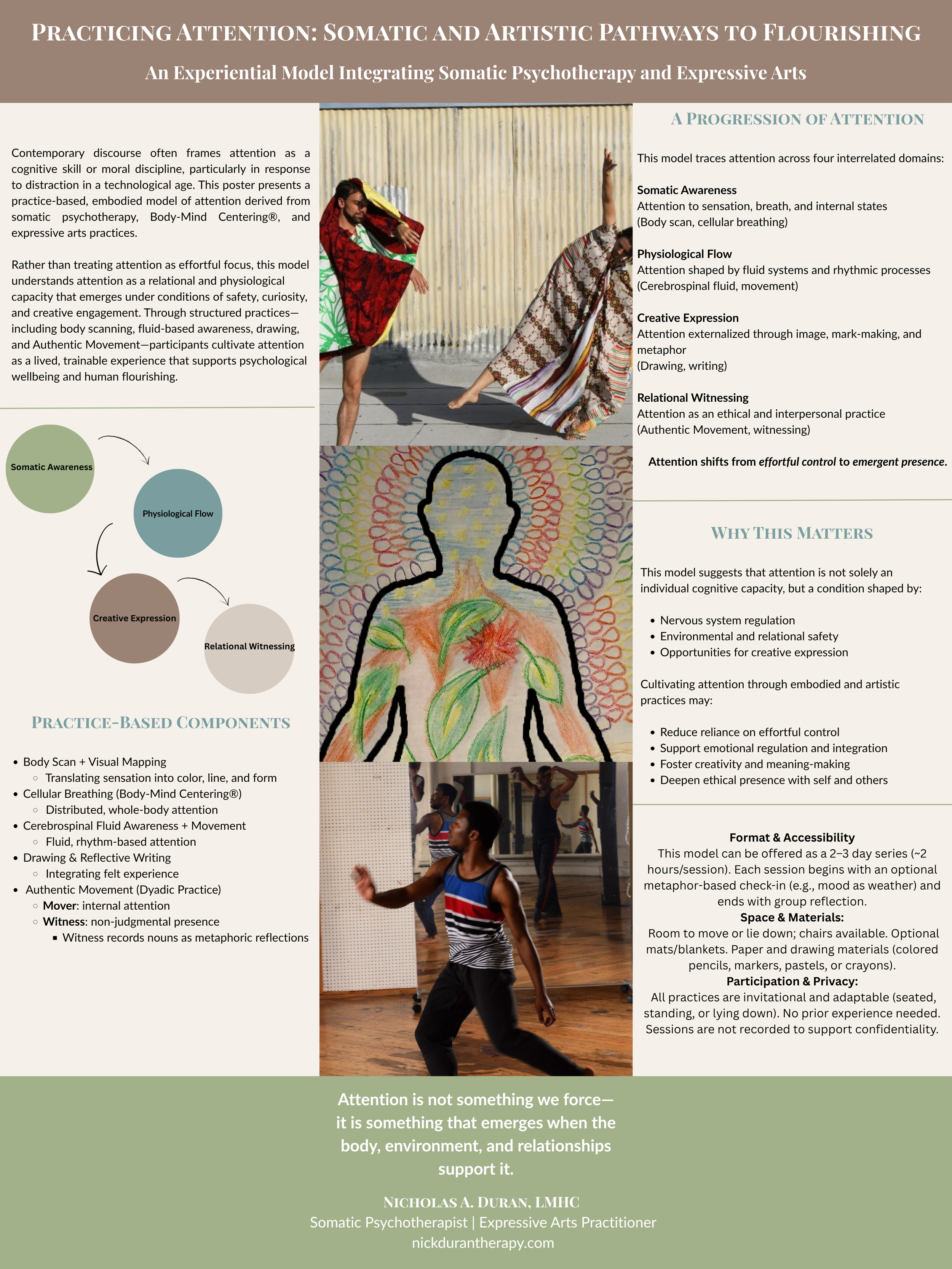
Drawing from clinical and artistic practice, the model traces attention across four interrelated domains: (1) somatic awareness, including sensation and breath; (2) physiological flow, with particular attention to fluid systems and rhythmic processes; (3) creative expression, in which attention is externalized through image, mark-making, and metaphor; and (4) relational witnessing, where attention becomes an ethical and interpersonal act. These domains are illustrated through practices such as body scanning and visual mapping, fluid-based imagery and movement, reflective drawing or writing, and dyadic witnessing adapted from Authentic Movement.
By mapping these domains, the poster highlights how attention shifts from effortful control toward emergent presence as conditions become more supportive and integrated. This shift has implications for both mental health and artistic practice, suggesting that attention may be cultivated indirectly through somatic regulation, environmental design, and relational attunement.
This practice-based framework contributes to a broader understanding of attention as dynamic, trainable, and context-dependent. It invites reconsideration of how attention is fostered within therapeutic, artistic, and everyday settings, and how such approaches may support more expansive and humane notions of flourishing.
Bio
Since 2008, Nick has developed an integrative approach to teaching somatics grounded in his training as a Master of Fine Arts candidate in Dance at the University of Illinois. His work synthesizes modalities including Body-Mind Centering, Authentic Movement, the Feldenkrais Method, the Alexander Technique, Ideokinesis, and Skinner Releasing, bridging creative practice, pedagogy, and embodied inquiry.
Duran has taught somatics and dance across higher education institutions including the University of California, Los Angeles; California State University, Long Beach; Loyola Marymount University; the University of North Carolina Asheville; and Whitman College. As a counselor, he has facilitated therapy groups integrating somatic and expressive arts approaches, including I Am Not My Thoughts: Somatic Practices for Anxiety and Depression, In-Between and Beyond: Mind-Body Practices for the Non-Binary Experience, Safer Than Words, and You Are Welcome Here.
His work with professional artists includes long-running classes such as SEAT (Somatic and Expressive Arts Techniques) (2020–2025), Self Healing: We Are All Connected (2019–2020), and Physical Practice (2011–2015), as well as teaching Kundalini Yoga and Reiki. Across contexts, his teaching centers the body as a site of attention, creativity, and transformation.